Meditate with Friedrich's Wanderer above the Sea of Fog
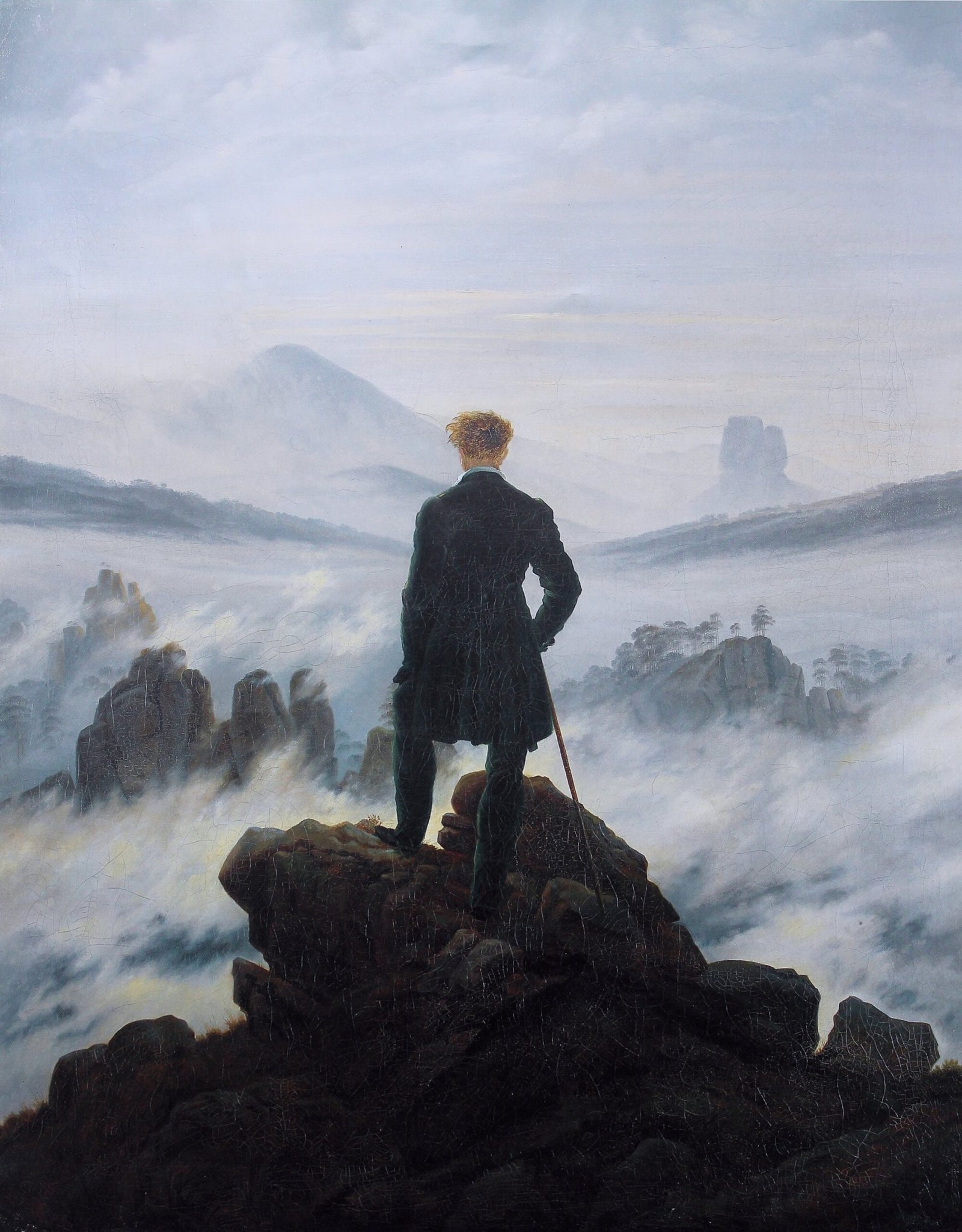
Caspar David Friedrich, Wanderer above the Sea of Fog, c. 1818. Oil on canvas, Hamburger Kunsthalle, Hamburg. Public domain.
The view from above the noise
Some tiredness has nothing to do with the lack of sleep. It's the feeling of being buried in your own days — messages, obligations, other people's urgencies — until you can't quite hear your own thoughts anymore.
This painting is what the opposite of that feels like. A man has climbed to the top of the mountain and stands now above the fog. All the everyday matters and worries stayed down. From up here it has become weather: something to watch, not something to drown in. He isn't conquering the place. He's just standing still in front of something far bigger than himself, and letting it resize him.
When Caspar David Friedrich painted The Wanderer above the Sea of Fog around 1818, he wasn't really painting rocks and mist. He believed a landscape should show what the painter carries inside as much as what sits in front of him. That's why this painting has become the universal image of introspection, a powerful representation of being in the present moment and stepping back from your own life to finally see it.
Why this painting quiets the sense of self
Philosophers and psychologists have a name for what this painting is intended to evoke: awe, the feeling that arrives in front of something so vast your mind can't grasp it instantly. Awe research has grown rapidly over the past two decades, and its findings are remarkably consistent: in a state of awe, the self gets quieter. People describe feeling smaller in a pleasant way, their inner monologue settles, everyday worries recede, and time feels briefly more spacious. The mental chatter that exhausts you is, at its core, self-referential, and awe turns its volume down.
Usually, to feel such a thing you'd need to climb a real mountain, or stand before some other stretch of nature vast enough to take your breath away. Friedrich's genius lies in the composition of the scene, more precisely in the figure itself: the wanderer stands with his back to us, exactly where we would stand. You don't merely observe his experience: you're invited to step into it and live it. Instead of simply trying to capture the sense of awe, the painting conveys it to you.
Two minutes above the fog — guided
This excerpt begins where the meditation turns to the painting itself. The full 10-minute version, with the settling-in at the start and the gentle return at the end, is in the free Essential Art Wanderer's Kit below.
How to look: a five-step slow-looking guide
You can do this right now, with the painting above. The magnifier is your museum step-closer.
- Arrive first. Before you look at anything in particular, take three unhurried breaths. Let your shoulders drop. You're not studying a painting; you're visiting one.
- Take the wanderer's place. His back is turned for a reason: that spot on the rock is being held for you. Imagine the wind, the solid stone under your feet, the cool air after a climb. Stay there a moment before you look at anything else.
- Let your eyes drift with the fog. Follow the mist as it pours between the ridges. Don't try to identify places; resist the urge to name shapes of objects you perceive. Where it hides the landscape, let it. Not knowing what's underneath is part of the rest.
- Hold both feelings. Somewhere in you there may be two things at once: the freedom of standing above it all, and a small shiver at how vast it is. You don't have to choose. Two centuries of viewers have felt exactly this double pull. It has a long philosophical name, but your body understands it without one.
- Come back resized. Before you leave, glance once more at the fog. Everything that felt urgent this morning is somewhere under there. Notice whether it looks different from up here. Take that altitude with you.
This view doesn't exist. Every rock in it does.
Bring the magnifier to the peaks around the wanderer. Each of these rock formations is real: Friedrich hiked the sandstone mountains of Saxon Switzerland and sketched them one by one, on separate walks, in his notebooks. Then, in the studio, he assembled them into a single panorama that exists nowhere on Earth. You could visit every rock in this painting, but you could never stand in this view.
Which means the landscape you've been resting in isn't a place — it's a composition of memories, arranged into the view the painter needed. There's something quietly comforting in that: the vantage point above the fog doesn't have to be found. It can be built, from pieces of what you already carry.
Wander further — the full experience is free
You've just tasted two minutes of it. The Essential Art Wanderer's Kit is the whole journey: the full 10-minute guided art meditation on this painting, and a 6-minute art exploration video that tells its story. You'll discover the movement and the philosophical tradition it belongs to, but also the quiet device Friedrich used to pull you inside, and what this landscape meant to him.
No art knowledge or meditation experience required.
Delivered by email, along with occasional letters from me. I read and reply to everyone.
Questions I hear most
Is this really the painting Art Wanderer Lab is named after?
It is. The "Art Wanderer" is this figure, an open-minded, curious person looking for new paths and meaningful encounters in life, and also the wandering mind that meditation works with. Instead of fighting the wandering, we give it somewhere beautiful to go, and a painting to gently anchor it. The "Lab" is the other half of the story: everything here is imbued with the spirit of inquiry and grounded in research. One painting managed to hold all of that, which is why it's the heart of the free kit.
What if my mind keeps wandering?
Then you're in good company: you're standing next to a professional. Noticing that you've wandered and coming back is the exercise: one repetition for your attention, like one rep at the gym. This painting makes the return easier than breath-based meditation for many people (especially if you have ADHD or any other attention difficulty): there's always something to come back to.
Is this actually backed by science?
Yes. Research on awe shows measurable effects of vast views, even reproduced ones, on self-focus and rumination. The wider evidence is just as solid: in 2019 the World Health Organization reviewed more than 3,000 studies and concluded that the arts have a genuine role to play in health and well-being. And a 2025 systematic review focused specifically on viewing art, exactly what you just did on this page, found consistent links to better mood and lower stress. Sources below, if you want to check for yourself.
Sources & further reading
- Keltner, D. & Haidt, J., "Approaching awe, a moral, spiritual, and aesthetic emotion," Cognition and Emotion 17(2), 297–314 (2003) — the founding paper of modern awe research.
- Bai, Y. et al., "Awe, the diminished self, and collective engagement: universals and cultural variations in the small self," Journal of Personality and Social Psychology 113(2), 185–209 (2017) — the "drawing yourself smaller" studies.
- Fancourt, D. & Finn, S., What is the evidence on the role of the arts in improving health and well-being? WHO Health Evidence Network report 67 (2019).
- Koerner, J. L., Caspar David Friedrich and the Subject of Landscape (1990) — the classic study of Friedrich's composed landscapes.
- Trupp, M. et al., "The impact of viewing art on well-being—a systematic review of the evidence base and suggested mechanisms," The Journal of Positive Psychology 20(6), 978–1002 (2025).
- Hamburger Kunsthalle, collection entry for Wanderer above the Sea of Fog — dating and provenance.
The magnifier works here too · press Esc or click outside the painting to close