Meditate with Hilma af Klint's The Ten Largest No. 7
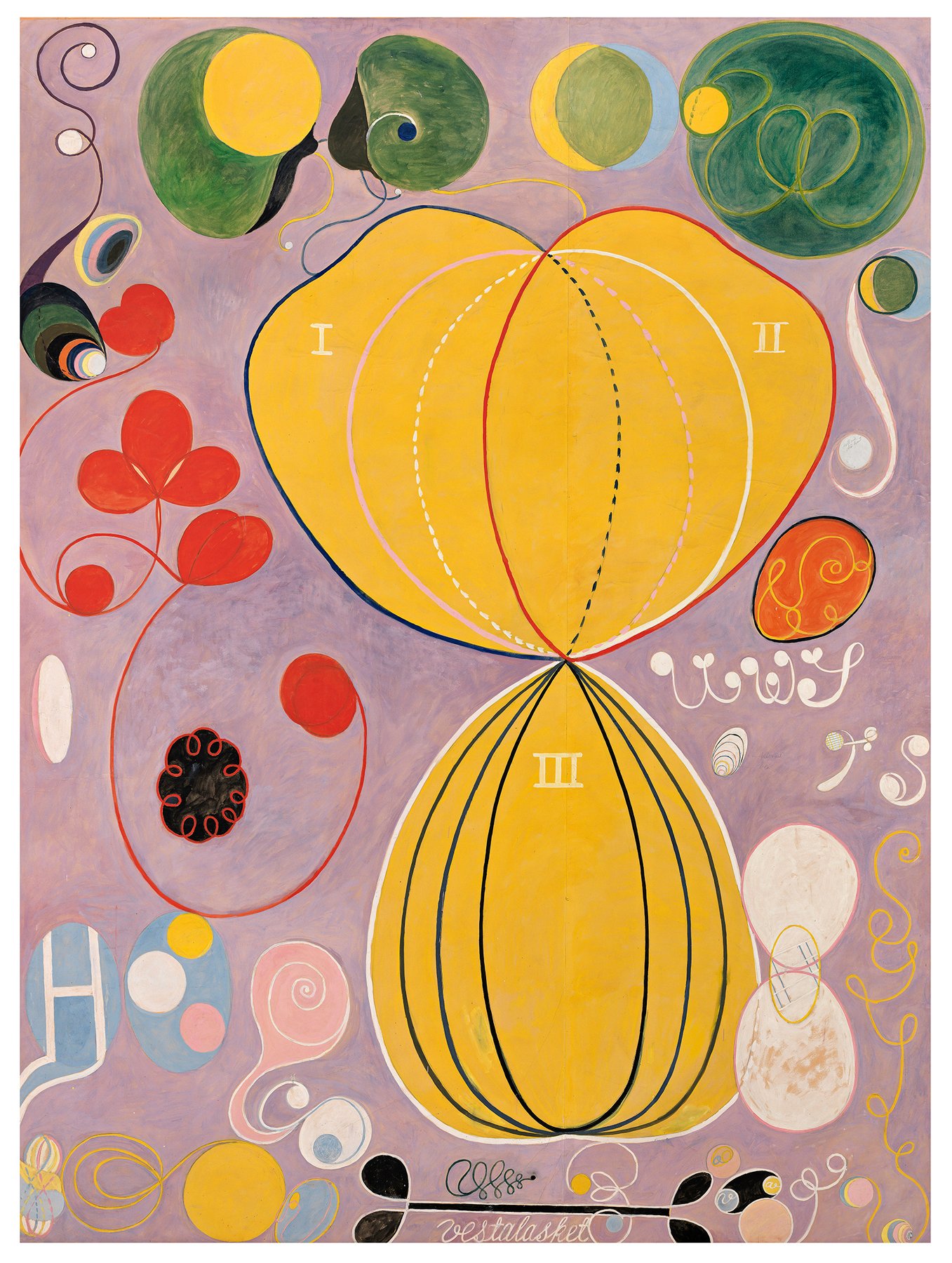
Hilma af Klint, The Ten Largest, No. 7, Adulthood, 1907. Tempera on paper mounted on canvas, Hilma af Klint Foundation, Stockholm. Public domain.
A painting that refuses to explain itself
Somewhere along the way, wondering got replaced by looking things up. Any question your mind produces is settled in eight seconds by the phone already in your hand. The strange, delicious state of not yet knowing? You've barely felt it in years.
This painting cannot be looked up. More than three meters of pale lilac, and on it: shapes that almost name themselves and then refuse. You'll see petals, or planets. A seed, or a heart, or an hourglass. Circles that could be cells dividing or moons in eclipse. The moment your mind settles on an answer, some small detail quietly disagrees, and the wondering starts again. That is precisely what makes this painting so mesmerizing.
Hilma af Klint made it in Stockholm in the autumn of 1907, on paper laid flat on her studio floor because no easel could hold it. She was an academy-trained, respected artist in her mid-forties who believed she had received a commission from a higher consciousness: to paint the stages of a human life for a temple that did not yet exist. The series is called The Ten Largest, and No. 7 is adulthood. Whatever you make of her beliefs (we'll get to that below), she painted the very stage of life you may be standing in right now, and she left the meaning open on purpose.
Why a mind enjoys a meaning it has to make
Art historians have a lovely name for what happens when you look at a painting like this: the beholder's share, the part of the picture that only comes into being once your mind starts completing it. With abstract art, your share is enormous. And it turns out we like the work.
In a well-known experiment, psychologists showed people artworks alongside statements that either matched or contradicted what they were seeing, and the pictures people found most interesting were not the fully explained ones: they were the ones that kept a moderate amount of ambiguity alive (Jakesch & Leder, 2009). A little not-knowing, it seems, is part of what makes looking pleasurable.
Few paintings hold that state open the way this one does. Every form sits at the edge of recognition: botanical but not quite a flower, anatomical but not quite a body, astronomical but not quite a sky. Your mind keeps proposing meanings and gently revising them, and because nothing ever fully resolves, the proposing itself becomes the meditation.
There is a bonus, too. In a 2020 study from Columbia University, people viewing abstract paintings shifted into a broader, more distant mode of thinking than people viewing figurative ones, the mental register of the big picture rather than the to-do list (Durkin et al., 2020). Ten minutes here is, quite literally, time spent further away from your inbox and the hassles of everyday life.
The part that still amazes me: Hilma af Klint finished this painting in 1907. Kandinsky, credited for a century as the inventor of abstract art, would not make his first abstract works until around 1911. Af Klint got there a few years earlier, in near secrecy, with a complete spiritual system behind every color and curve. And her paintings were never mere decoration. They were, and still are, a deeply symbolic message about human life.
Convinced the world was not ready for it, she stipulated that these works stay unseen for twenty years after her death. If anything, she was generous: it took more than forty. When the Guggenheim finally gave her a full exhibition in 2018, it became the most-visited show in the museum's history. The painting above waited a century for your attention. Take your time with it.
How to look: a five-step slow-looking guide
You can do this right now, with the painting above. The magnifier is your museum step-closer.
- Arrive first. Before you look at anything in particular, take three unhurried breaths. Let your shoulders drop. You're not studying a painting; you're visiting one.
- Let it be big. In life this sheet stands more than three meters tall: adulthood apparently needed the largest possible page. Take in the whole painting at once, as pure weather: lilac, yellow, green, a scatter of red. Name the colors, not the things.
- Follow one edge. Choose the great yellow form at the center and travel its outline slowly, the way you'd trace a coastline on a map. Notice where the two upper lobes overlap, and where the third form hangs below them from a single meeting point. Glide the magnifier along that boundary and watch the color waver at the edge, where her brush decided things.
- Go small. Now hunt for the painting's whispers: tiny white letters looping like handwriting to the right of the center, Roman numerals resting on the yellow, red blossoms riding curled tendrils on the left. Let each find suggest something, then allow it to change its suggestion. Nothing you guess is wrong. Nothing you guess is final, either.
- Return to the whole. Zoom back out and rest on the full composition for a minute. Notice how the guessing has quieted into plain watching. If your thoughts drifted somewhere along the way, that isn't failure; that's simply what minds do. The yellow is still there, and coming back to it is the whole exercise.
Af Klint labeled the mystery like a botanist
Bring the magnifier just to the right of the painting's center and you'll find a row of small white characters looping like cursive handwriting: the letters U and W. They are not decoration. Af Klint kept a private dictionary, a notebook titled Symboler, Bokstäver och Ord tillhörande Hilma af Klints målningar (Notes on Letters and Words pertaining to Works by Hilma af Klint), where she recorded what her signs meant: U stands for spirit (the spiritual world), W for matter (the physical world). And sitting calmly on the great yellow forms are Roman numerals, I, II, III, as if the vision arrived with its own legend. It makes sense once you know that af Klint earned part of her living as a scientific illustrator, drawing plants and anatomy with documentary precision. Here she paints the invisible with the same discipline, like a plate from a textbook that was never written.
I find that combination quietly moving: a person standing before something she couldn't fully understand, choosing to take careful notes anyway. Adulthood asks the same of most of us. You will not be handed the complete key to your own life either, and you can still mark what you can, spirit here, matter there, and keep drawing. Precision and mystery were never opposites. This painting is the proof.
Liked looking this way? Try being guided
This page is the self-guided version. In the free Essential Art Wanderer's Kit, a calm voice does the guiding for you. Try a 10-minute art meditation and a 6-minute art exploration on Friedrich's Wanderer above the Sea of Fog, the painting our name comes from. No art knowledge or meditation experience required.
Get the free kitDelivered by email, along with occasional letters from me. I read and reply to everyone.
Or keep wandering on your own: more paintings to sit with are waiting in the library.
Questions I hear most
What do the shapes in this painting actually mean?
Honest answer: nobody knows for certain, and that includes the experts. Af Klint left notebooks decoding parts of her language: yellow stands for the masculine principle, blue for the feminine, U for spirit, W for matter, the spiral for development and growth. The Ten Largest series maps the four ages of a human life, and No. 7 belongs to adulthood. But she never explained the whole composition, and the painting doesn't require you to. Meaning here isn't a password to find. See it as a process to sit inside. The wondering is the practice.
Do I need to share the artist's spiritual beliefs to meditate with this?
Not at all. Af Klint's séances can sound eccentric today, but in 1907 spiritualism was a serious current in European intellectual life, explored by scientists and writers alike. She was a person of her time, asking the era's biggest questions with a paintbrush. You can meet this painting as she framed it, a message about the stages of life, or purely as three meters of color and form doing gentle work on your attention. Both are full experiences. The painting has no entry requirements.
What if my mind keeps wandering?
Then you're in good company — you're standing next to a professional. Noticing that you've wandered and coming back is the exercise: one repetition for your attention, like one rep at the gym. Many people find the return easier with this kind of slow looking than with breath-based meditation: there's always something to come back to.
Is this actually backed by science?
Yes. Studies of how we respond to abstraction show real effects: viewers stay most engaged with images that keep some ambiguity alive, and looking at abstract art shifts thinking into a measurably broader, more distant register than figurative art does.
The wider evidence holds up as well: in 2019 the World Health Organization mapped the findings of more than 3,000 studies and found a real place for the arts in health and well-being. Most recently, a 2025 systematic review gathered the research on simply looking at art (no making involved), and the pattern held: better mood, lower stress. All of it is listed below, if checking sources happens to be your kind of meditation.
Sources & further reading
- Jakesch, M. & Leder, H., "Finding meaning in art: Preferred levels of ambiguity in art appreciation," Quarterly Journal of Experimental Psychology 62(11), 2105–2112 (2009) — the study showing that a living dose of ambiguity is part of what makes art absorbing.
- Durkin, C., Hartnett, E., Shohamy, D. & Kandel, E. R., "An objective evaluation of the beholder's response to abstract and figurative art based on construal level theory," Proceedings of the National Academy of Sciences 117(33), 19809–19815 (2020) — the Columbia study on abstract art and psychological distance.
- Trupp, M. et al., "The impact of viewing art on well-being—a systematic review of the evidence base and suggested mechanisms," The Journal of Positive Psychology 20(6), 978–1002 (2025).
- Fancourt, D. & Finn, S., What is the evidence on the role of the arts in improving health and well-being? WHO Health Evidence Network report 67 (2019).
- Moderna Museet, collection guide entry for The Ten Largest — how the series was painted: egg tempera on paper on the studio floor, each work in about four days.
- Bashkoff, T. (ed.), Hilma af Klint: Paintings for the Future, Solomon R. Guggenheim Museum (2018) — the catalogue of the exhibition that brought the artist to a vast new audience.
The magnifier works here too · press Esc or click outside the painting to close