Meditate with Van Gogh's The Starry Night
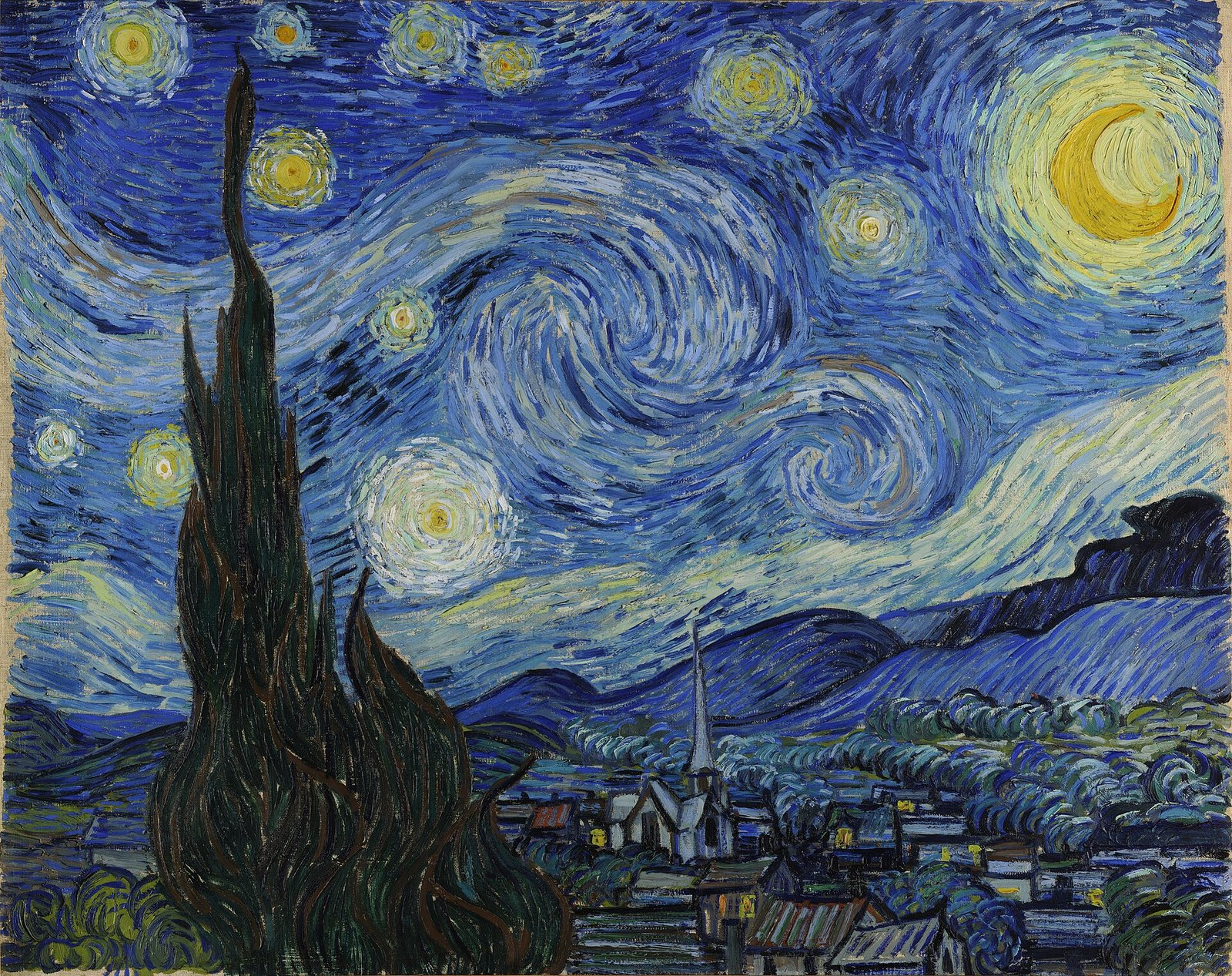
Vincent van Gogh, The Starry Night, 1889. Oil on canvas, Museum of Modern Art, New York. Public domain.
A sky that moves, so your mind doesn't have to
You know that state where you finally sit down to rest and your mind keeps scrolling without a phone? Tabs still open, to-do list still humming, and somewhere underneath it, a quiet guilt that you're not even resting properly.
This painting was made for exactly that mind. The Starry Night is one of the most restless images ever painted — the whole sky is in motion — and yet almost everyone who stands in front of it reports the same thing: they slow down. That's not a coincidence, but it's not mysticism either. It's how your visual attention works (more on the science in a moment).
Van Gogh painted it in June 1889, from the window of his room at the asylum in Saint-Rémy-de-Provence. Partly from observation, partly from memory and imagination. It's a turbulent picture, painted in search of calm. If you've ever felt that your own restlessness and your longing for stillness live in the same head, this painting already understands you.
Why this painting calms a busy mind
Attention researchers distinguish between two ways of paying attention. The first one is the effortful kind: spreadsheets, emails, willing yourself to focus. It's a limited resource, and modern life drains it daily. The second one, the restorative kind, is what Rachel and Stephen Kaplan called soft fascination: attention that is held gently, without effort, the way you watch clouds or a fire. It's the state in which the depleted focus system actually recovers.
The Starry Night is almost purpose-built for soft fascination. Its swirling sky gives your eyes a path to follow. There's always somewhere to go next, but nothing demands analysis, decision, or response. Your attention is occupied and at rest at the same time. (For many people who find breath-focused meditation boring or effortful, this is the difference that finally makes it work.)
The part that still amazes me: in 2024, physicists analyzed the swirls of this sky and found that their scale and spacing follow the statistical patterns of real atmospheric turbulence. The mathematics of moving air, painted by eye, by a man in distress, more than a century before anyone could measure it!
Your visual system evolved to read exactly these natural patterns, which may be part of why the sky feels alive rather than chaotic (Ma et al., Physics of Fluids, 2024). Try the magnifier on the sky and you'll see the turbulence brushstroke by brushstroke.
How to look: a five-step slow-looking guide
You can do this right now, with the painting above. The magnifier is your museum step-closer.
- Arrive first. Before you look at anything in particular, take three unhurried breaths. Let your shoulders drop. You're not studying a painting; you're visiting one.
- Take in the whole. Let your eyes rest on the entire canvas without landing anywhere, the way you'd take in a view from a train window. Ten seconds is enough. Notice the first thing that pulls at you. Don't follow it yet.
- Ride the sky. Now let your gaze travel with the swirls, at their pace, not yours. Bring the magnifier to the big central spiral and follow one current of blue until it hands you to the next. If your mind wanders (it will, mine does too), the sky is very forgiving: just get back on wherever you are.
- Find the stillness. Drop your eyes to the village. The church tower, the small lit windows, everything holding perfectly still under all that motion. Rest there a moment. Notice what changes in your body when the movement stops.
- Place yourself. Before you leave, ask one small question: where am I in this picture, the sky or the village? There's no right answer. Notice how you feel now compared to five minutes ago, and take that with you.
The windows and the stars are the same yellow
Take the magnifier down to the little village: the lit windows glow with the same yellow Van Gogh gave the stars. It's one pigment doing two jobs: the cosmic and the domestic, a star and a kitchen lamp, painted as the same kind of light. So the painting holds both of the things your tired mind is usually torn between: the vast, moving, overwhelming world, and one cozy place, warm light on, that feels like home.
One more art historian's footnote for the keenest observers: that slender church spire is more Dutch than Provençal. Van Gogh, painting in the south of France, seems to have placed a memory of home under his turbulent sky.
Liked looking this way? Try being guided
This page is the self-guided version. In the free Essential Art Wanderer's Kit, a calm voice does the guiding for you. Try a 10-minute art meditation and a 6-minute art exploration on Friedrich's Wanderer above the Sea of Fog, the painting our name comes from. No art knowledge or meditation experience required.
Get the free kitDelivered by email, along with occasional letters from me. I read and reply to everyone.
Questions I hear most
Do I need to see the real painting in a museum?
No, and this matters. Slow looking works with a good reproduction on a screen or a print on your wall. The museum version is wonderful (and worth the pilgrimage to MoMA one day), but the practice lives wherever you are. A painting you visit regularly on your desk beats a masterpiece you saw once.
What if my mind keeps wandering?
Then you're doing it correctly. Noticing that you've wandered and coming back is the exercise: one repetition for your attention, like one rep at the gym. The painting makes this easier than breath-based meditation for many people (especially if you have ADHD or another attention difficulty): there's always something to come back to.
Is this actually backed by science?
Yes. Research in neuroaesthetics and attention restoration shows that engaging with art can reduce stress and support the recovery of focus. In 2019, the World Health Organization reviewed more than 3,000 studies and concluded that the arts have a genuine role to play in health and well-being, which is a striking thing for a public health body to say about paintings.
And the evidence keeps arriving: a 2025 systematic review looked specifically at viewing art, the thing you just did on this page, and found consistent links to better mood and lower stress. Sources below, and they're worth reading on their own.
Sources & further reading
- Kaplan, R. & Kaplan, S., The Experience of Nature: A Psychological Perspective (1989) — the origin of attention restoration theory and "soft fascination."
- Ma, Y. et al., "Hidden turbulence in van Gogh's The Starry Night," Physics of Fluids 36 (2024) — the turbulence analysis of the painted sky.
- Aragón, J. L. et al., "Turbulent luminance in impassioned van Gogh paintings," Journal of Mathematical Imaging and Vision 30, 275–283 (2008) — one of the foundational studies on the turbulence in van Gogh's works.
- Fancourt, D. & Finn, S., What is the evidence on the role of the arts in improving health and well-being? WHO Health Evidence Network report 67 (2019).
- Trupp, M. et al., "The impact of viewing art on well-being—a systematic review of the evidence base and suggested mechanisms," The Journal of Positive Psychology 20(6), 978–1002 (2025).
- Museum of Modern Art, collection entry for The Starry Night — dating, provenance, and the Saint-Rémy context.
The magnifier works here too · press Esc or click outside the painting to close