In this article, I want to talk about the science behind mindful art engagement and, more specifically, introduce you to art meditation. But before we dive into the science, let’s take a quick trip back in time.
How I Discovered Art Meditation
It was a sunny Tuesday in Paris, back in 2023. I was excited because I was going to try something new—meditating with works of art in a museum. At the time, I was already a huge fan and practitioner of mindfulness meditation, so the idea of connecting it with art resonated deeply with my art historian’s heart.
In the museum lobby, I met other participants. I won’t lie, we weren’t numerous. The fact that the museum organized the event at 1 pm on a Tuesday might have played a role. Let’s be honest, not everyone has time to contemplate art in a museum during their lunch break, especially since this type of art engagement still sounds quite exotic for most people.
Once our small group was gathered and equipped with headphones and yoga mats, we finally entered the exhibition. It was a retrospective of the Norwegian abstract artist Anna-Eva Bergman. The experience commenced!
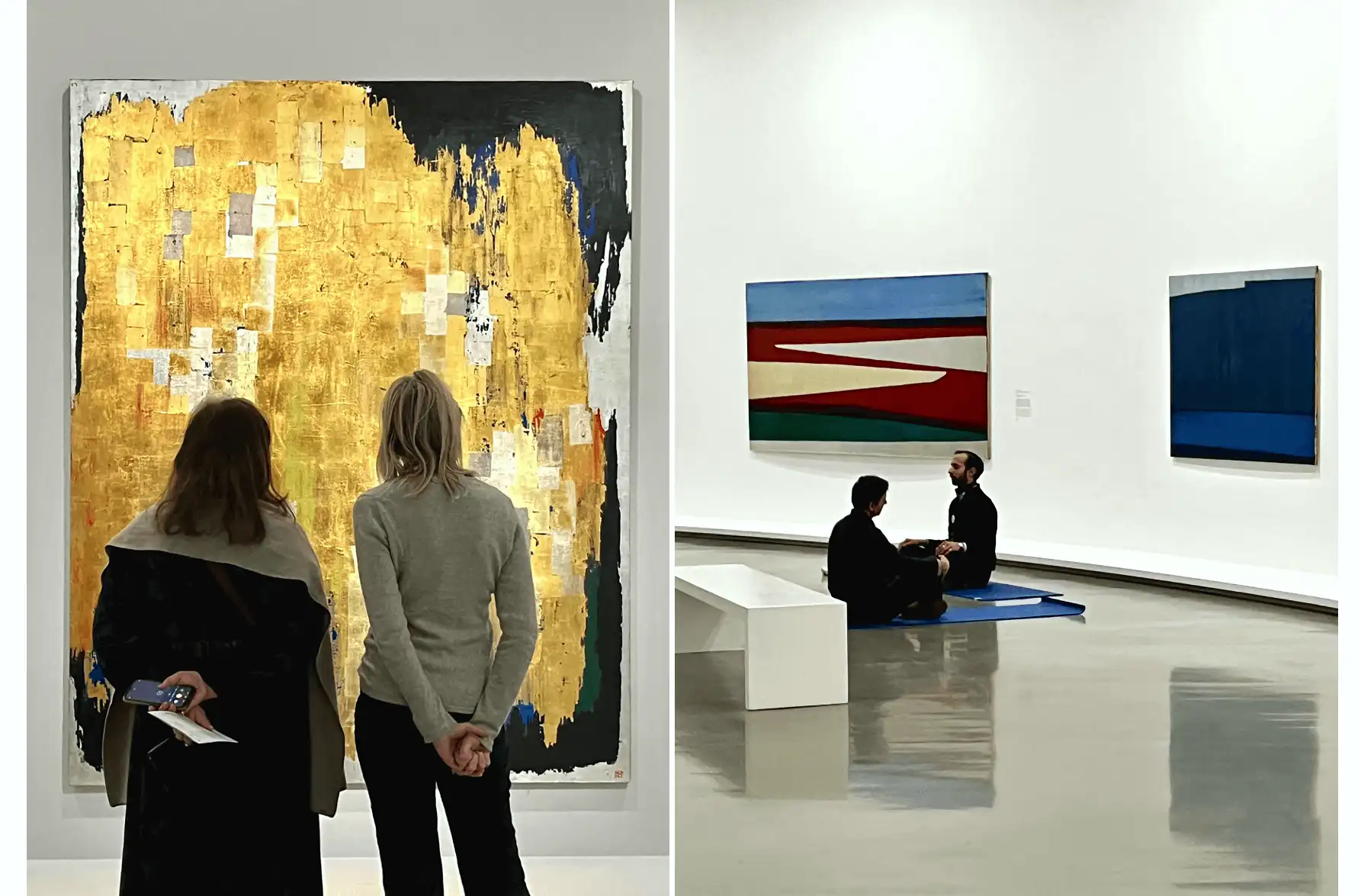
What happened next was simple yet extremely refreshing. We sat in front of the first artwork and slowly plunged into its universe, guided by our guide’s gentle instructions. After about 20 minutes of meditation, we repeated this exercise with a different painting. As a researcher with a PhD in art history and theory, I was used to engaging with art intellectually most of the time; this was a welcome shift from analysis to pure experience.
You may wonder whether it was hard to focus and enter a meditative state in a museum room with people moving around. Well, only for a few moments at the beginning. But after that, I felt fully immersed in the artwork. It was almost as if everything around me disappeared. I tuned into the painting and into my sensations at the same time, and by the end of the practice… I found myself extremely relaxed and calm. It truly surprised me because I didn’t expect to feel this way after meditating in a public space for the very first time!
This experience has changed how I look at art in many ways.
Beyond the Museum: A New Way to Experience Art
After that, I tried many different ways to engage more mindfully with art. I tested in-person and online experiences, enjoyed most of them, but often felt that something was missing. I heard similar sentiments from other participants I spoke with.
All this time, I sensed the urge to find my own way to connect art, art history, and mindfulness, and to share it with others in the most accessible way. Why?
Because the simplicity and the unquestionable power of the mindful art experience are a real thing. And even though art meditation is becoming increasingly popular in museum settings, it still remains a rather exclusive experience. This isn’t just because it’s niche and may be intimidating for complete meditation novices, but also for a practical reason: you need to be physically in the right place and at the right time to participate.
From this reflection, the idea of the Art Wanderer’s Kit (Art Meditation) emerged, and my Art Wanderer Lab’s method was born. It’s a method that gently links the contemplation of works of art with learning about art history. It offers you the opportunity to connect with art on a deeper level at any time and place you choose, as well as to expand your understanding of art history without the effort of intentional study.
But it’s not only about exploring art. It’s also, and above all, about you! After all, what hasn’t changed for ages is that a work of art is a remarkable tool for introspection, a prism through which we can look into ourselves and discover our emotions, feelings, and hidden dreams.
Moreover, as a researcher, I find it particularly important that this intimate and, for some, deeply spiritual experience—which art meditation may be—is also strongly grounded in science, connecting the benefits of both mindfulness practice and art engagement.
So, if science speaks to you too, let’s dive into more details!
The Science: How Art and Meditation Impact Your Health and Well-being
MBSR and Its Evidence-Based Benefits for Health
I’ll start with meditation, as it seems widely known now that mindfulness meditation, the secular, science-based practice of awareness and being fully in the present moment, is highly beneficial for our mental and physical health.
For the past 15 years, researchers have studied the impact of the MBSR (Mindfulness-Based Stress Reduction) program, developed by Dr. Jon Kabat-Zinn of the University of Massachusetts Medical School, on individuals of various ages. This method, consisting of an eight-week training in mindfulness practice, has been proven to reduce anxiety and depression while improving overall health, well-being, and performance, especially among adolescents and young adults.
Numerous papers and meta-analyses point to tangible results in this area. New research on mindfulness-based interventions shows that they support self-regulation in young children and have the potential to improve health and coping skills in older adults. MBSR methods are not only effective for soothing mental symptoms and disorders but also contribute to successfully managing chronic pain (for a more extensive list of studies, see the “Sources & Further Reading” section).
Having completed the eight-week MBSR training myself, I can attest to its effectiveness. It offers a variety of extremely useful techniques for focus and relaxation that one can use at any time to regulate their nervous system.
There is no doubt that mindfulness works. The fact that it is now part of many medical programs and officially approved therapies, and that more and more universities across the globe are introducing it into their course offerings, proves it.
What about art then?
Art & Health’s New Era
It might be a bold claim, but I think we are experiencing a revolution in the way we perceive art as a society. For ages, for most of us, and especially for policy makers, it was a matter of taste, prestige, and power.
The truth is that art and art history have long been dominated by the intellectual and economic elite, inaccessible to much of society and, by extension, quite incomprehensible. Those in power perceived art as a means of demonstrating their influence and supremacy.
Today, access to art is much more democratized, and we are even seeing a boom in online art education. Art and art history are everywhere, from museum websites and dedicated platforms to Instagram accounts sharing facts and curiosities about famous artists.
But the real revolution is scientific: advances in neuroscience and neuroaesthetics provide growing evidence of the positive impact of mindful engagement with art on our health and well-being.
Mindful Art Engagement Benefits According to Science
From the WHO report on the role of the arts in improving health and well-being, through numerous scientific articles, to wider-audience publications such as “Your Brain on Art: How the Arts Transform Us” and “Art Cure: The Science of How the Arts Transform Our Health,” we are beginning to realize that regular exposure to the arts should be part of our routine, just like eating healthy and exercising.
The benefits of mindful art engagement are very similar to those of physical activity. It helps maintain mental balance, reduce stress, increase life satisfaction, and promote longevity. It also contributes to preventing Alzheimer’s disease and dementia. Neuroscience shows that aesthetic experiences have a significant impact on us, both psychologically and physiologically.
If you want to learn more about this topic, check out the books I mentioned above or refer to the scientific papers listed at the end of this article.
And if you’re not a big fan of art-making, I have good news for you! You don’t need to sign up for drama classes, paint, or learn to play an instrument. Passive engagement with art, such as simply looking at a work of art (read more about slow looking here), is also beneficial for your health.
While admiring your favorite artist’s masterpieces in person at a museum is an unparalleled experience, it requires time and organization, especially if you have to travel to another city or country. However, you can enjoy them in the comfort of your own home with high-quality reproductions. In this case, what matters most is how you approach the artwork, ideally with full awareness.
This is precisely where art meditation comes into play.
Meditate Through Art, Discover Art Through Meditation: How It Works
In my search for connecting art, mindfulness, and art history—as an art historian deeply passionate about sharing knowledge and love for the art—I came across two realizations that became the basics of Art Wanderer Lab’s method:
-
The work of art should always be the starting point in order to approach it with an open, curious mind and discover it through senses-awakening contemplation/meditation,
-
Exploring the context of the creation of the artwork, its style, and technique should be an opportunity to dive deeper and expand the knowledge, not a must. It’s an invitation, not a prerequisite for connecting with the artwork.
In this way, art engagement remains an experience, an inspiring wandering hopefully leading to a real encounter with the meaning of the work of art (that can be very personal, intimate). It doesn’t require any prior knowledge or education that may condition our reception.
Imagine feeling a sense of deep calm, connection, and insight as you lose yourself in a masterpiece. Once you experience the artwork through meditation, you can decide whether you want to learn more about it or just enjoy the state it puts you in.
How does it work in practice?
The Essential Art Wanderer’s Kit consists of two videos: a 10-minute meditation with an artwork you start with, and a 6-minute explanatory video that helps you deepen your mindful art experience by learning a bit about its place in the long and rich history of art.
The Originality of the Approach
Let me share some thoughts from participants in a testing group who have already explored the materials I prepared.
“Meditating with a work of art was a totally new experience for me. I’d already tried regular meditation on several occasions, but meditating with a work of art brings added value. Focusing on the painting, on its details, soaking up the atmosphere enabled me to concentrate better on what I was seeing and prevent negative thoughts from “breaking through” to my mind. I also loved the guide’s voice! I felt like I was enveloped by its softness.”
This is what Ania, one of my students, said after her first meditation experience with a work of art.
And here’s another opinion, from Isabelle, who, before testing the Essential Art Wanderer’s Kit, was an occasional museum visitor but not a big art history or meditation adept:
“I used to think of meditation as something you did in silence, eyes closed, but now I see it as an opportunity to engage with beauty on a whole new level. These guided meditations not only calm my mind but also help me to see the nuances of the artwork in front of me. The educational aspect is a nice bonus. I love learning the history behind the paintings and how it ties into the practice. It’s such an innovative approach, and I’ll definitely try to incorporate it into my mental self-care routine!”
Whether you’re fascinated by the intersection of art, psychology, and neuroscience, or just open to new experiences, art meditation offers a unique way to explore the depths of both an artwork and your own mind.
Take the First Step
If you want to see how it works, I invite you to download your Essential Art Wanderer’s Kit for free by subscribing to my newsletter.
I’ll take you on a journey through Wanderer above the Sea of Fog, one of the most reflective and mysterious masterpieces by Caspar David Friedrich. This very painting was also an inspiration for me to create Art Wanderer Lab, and I’m convinced it will resonate deeply with you.
Ready to connect with art in a new way, reduce stress, and tap into your creative side? Just follow the gentle guidance offered in the Essential Art Wanderer’s Kit. Get your free kit now.
I’m excited for you to experience the insight and joy that art meditation can bring. Let me know what you discover!
FAQs
Art meditation uses a single artwork as an anchor for your attention. Through the combination of art and gentle mindfulness practice, it calms the nervous system, sharpens focus, and creates space for insight without requiring any prior knowledge of art.
Yes. Yes. A growing number of studies show that engaging with art mindfully is highly beneficial for our mental and physical health. Even passive forms of engagement with art, such as art mediation, have been proven to improve health and well-being in various populations. You can find more information about the benefits and supporting research in the “Sources & Further Reading” section and throughout the Art Wanderer’s Lab website.
No. You start with a sensory, mindful encounter with the artwork. Context comes after, as an optional layer, if you choose to dive into the Art Exploration video. It’s an invitation to deepen your experience, not a prerequisite to engage with the work of art.
No. Art meditation is a simple activity of contemplating the chosen artwork with gentle guidance that helps you immerse yourself in it and calm your mind. You don’t have to engage in any manual creative work in order to feel the benefits of this mindful art experience.
Start with 10 minutes, 2–3 times per week. Even short, regular sessions reduce stress and improve focus. The AWL’s Essential Kit includes a 10‑minute guided practice and a bonus video with a short art history lesson to deepen your experience if you want to learn more about the selected artwork.
Sources & Further Reading
Benefits of Mindfulness
Hue, VC, Siaw, YL, Mohamad, Nor A., “A systematic review of mindfulness-based stress reduction in the management of anxiety disorders among adolescents and young adults aged 13-26”, Asian Journal of Psychiatry, June 2025, 108:104497, doi.org/10.1016/j.ajp.2025.104497.
Lwi, SJ., Paulraj, SR., Schendel, K., Dempsey, DG., Curran, BC., Herron, TJ., Baldo, JV., “A Randomized, Controlled Pilot Study of Mindfulness-Based Stress Reduction in Healthy Older Adults”, Clinical Gerontologist, May-June 2023;46(3):330-345. doi.org/10.1080/07317115.2022.2137075.
Bockmann, JO., Yu, SY., “Using Mindfulness-Based Interventions to Support Self-regulation in Young Children: A Review of the Literature”, Early Childhood Education Journal, 2023;51(4):693-703. doi:10.1007/s10643-022-01333-2.
Robles, E., Blanco, I., Díez, G., Vázquez, C., “Mindfulness-based stress reduction for chronic pain: Enhancing psychological well-being without altering attentional biases towards pain faces”, European Journal of Pain, February 2025, Vol. 29, Issue 2, doi.org/10.1002/ejp.4714.
Benefits of Mindful Art Engagement
Fancourt, D., Art Cure: The Science of How the Arts Save Lives, Penguin/Macmillan, 2026.
Fancourt, D. & Finn, S., What is the evidence on the role of the arts in improving health and well-being? A scoping review, World Health Organization. Regional Office for Europe, 2019, https://iris.who.int/handle/10665/329834.
Magsamen, S., & Ross, I., Your Brain On Art: How The Arts Transform Us, Random House, 2023.
Worrell, C., Kirkpatrick, M., Ribeiro Perez, C., Fortuna, P., Bumbra, L., Bradnock, L., & Woods, A. J., “The Physiological Impact of Viewing Original Artworks vs. Reprints: A Comparative Study”, Psychological Medicine, King’s College London, 2025.
Filipowska, R., Weinberg-Wolf, H., & Vaghenas, A., “Being Present with Art: Mindful and Interactive Engagement with Art Lowers Stress While Increasing Attention and Belonging”, Journal of Museum Education, 2024:49(3), 334–347, doi.org/10.1080/10598650.2023.2217568.
Holt, N., Tischler, V., Corvo, E., Vougioukalou, S., (Eds.), The Routledge Handbook of Arts and Health, 2026.