The Mona Lisa’s enigmatic smile — who hasn’t heard of it? Most of us have seen it at least once, whether in the Louvre itself or on countless reproductions. Every year, Leonardo da Vinci’s masterpiece attracts millions of visitors, many of whom are convinced that Lisa Gherardini — identified by art historians as the sitter — not only smiles but also follows them with her gaze.
But how is that possible?
Perhaps da Vinci possessed some sort of supernatural gift that let him capture the slight twitch at the corner of her mouth and that wandering gaze in oil and pigment — or perhaps the answer lies in how our brains perceive the painting. Most likely, it’s both — and that’s exactly what makes this story so fascinating.
In this article, we’ll dive into neuroaesthetics, the discipline that focuses on aesthetic experience and examines how art and beauty impact the brain, to see how science explains this phenomenon.
The Brain and Figurative Art
Without questioning da Vinci’s genius, let’s assume the truth about Mona Lisa’s magical smile is a bit of both.
What we do know, thanks to neuroscientific studies of art perception, is that our brains react in a very particular way to figurative art, especially to depictions of people, including portraits such as La Gioconda (by the way, did you know that it’s how Italians refer to this beautiful lady, after her husband’s name, Francesco del Giocondo?).
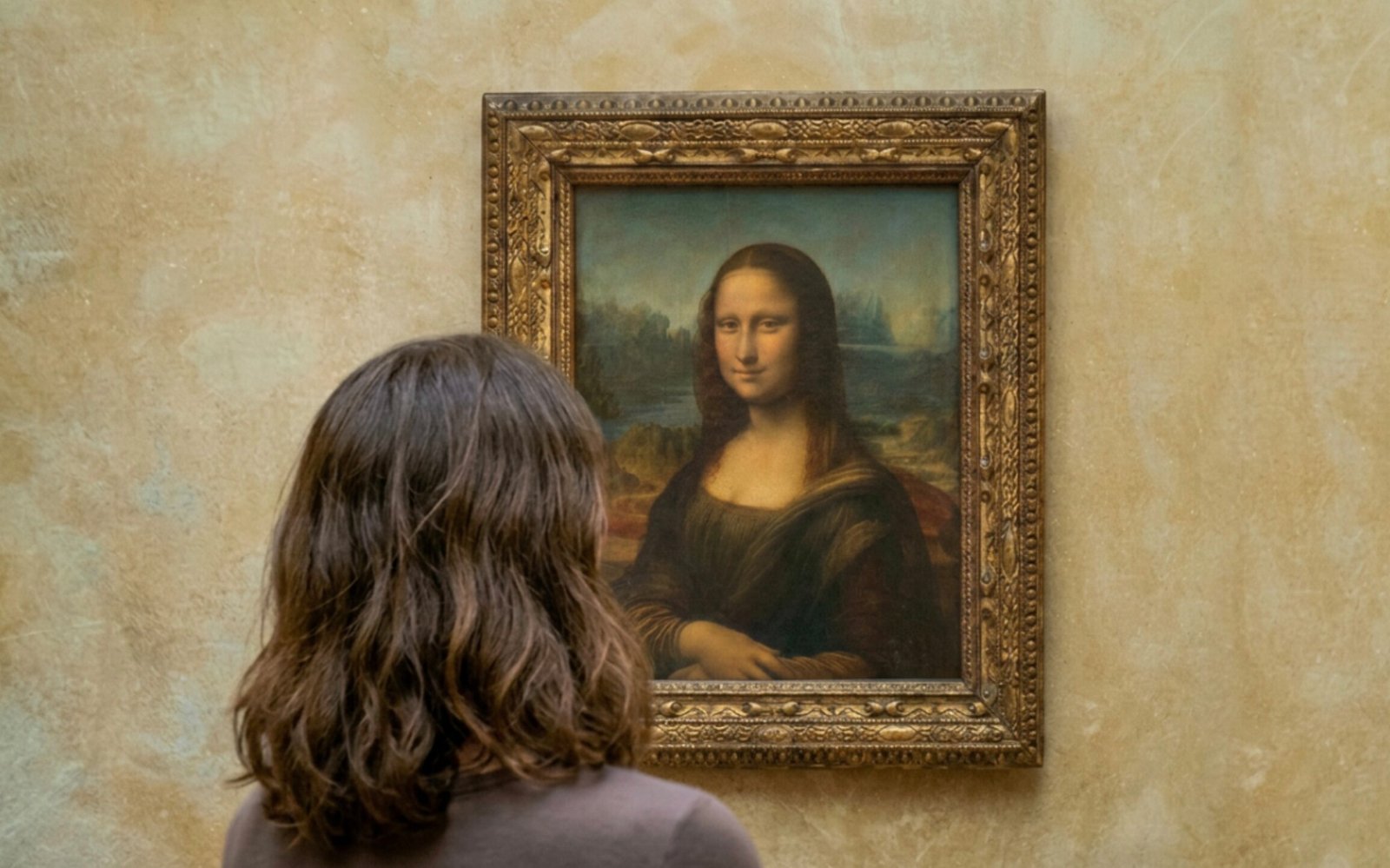
French neurobiologist Pierre Lemarquis, who studies the impact of art on the brain, explains it like this:
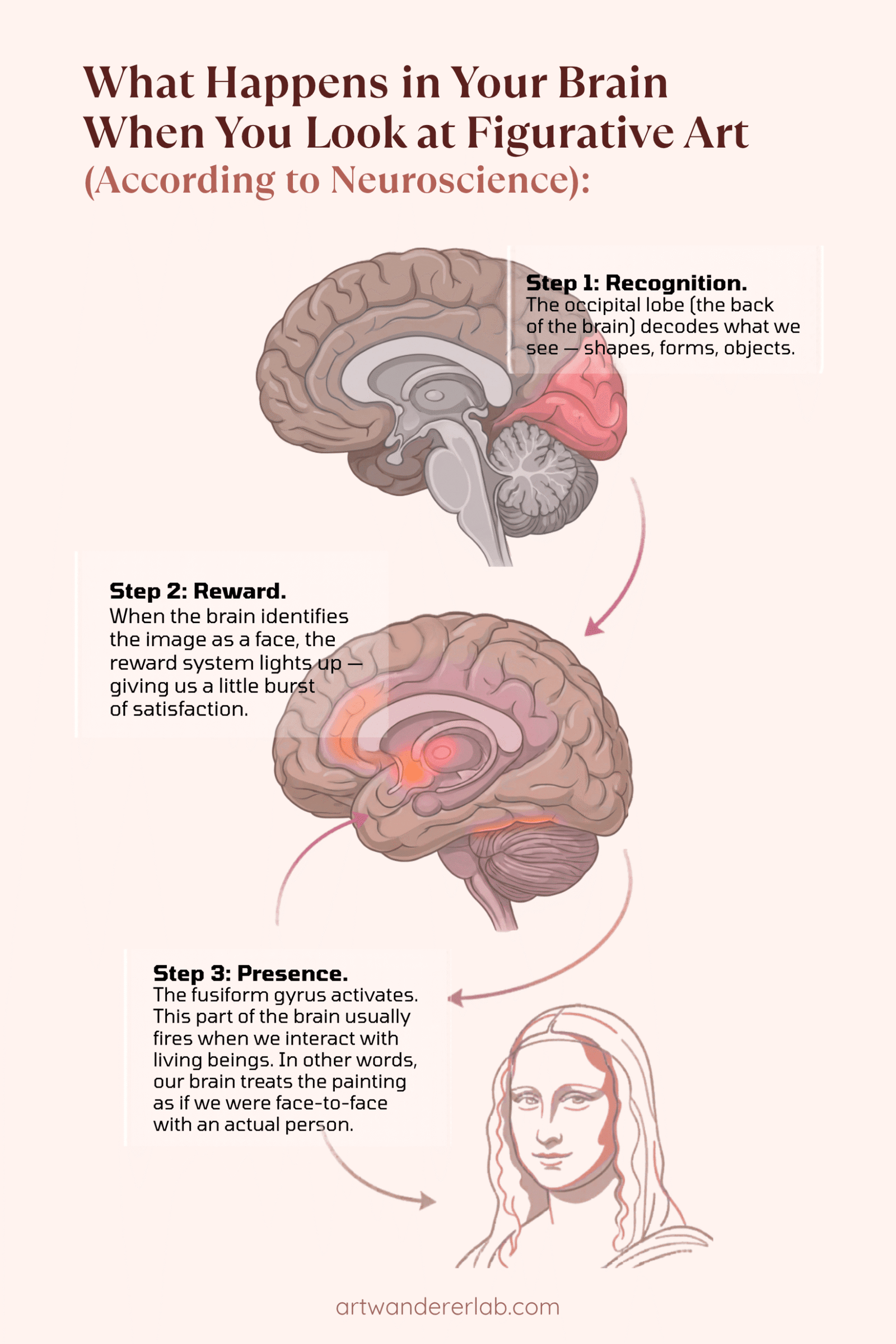
When we look at a work of art, the back part of the brain — the occipital lobe — switches on first. It is responsible for decoding what we see: recognizing shapes, forms, and objects. Next, when the object is recognized as a face — and especially this face, the most famous in the world — the brain’s pleasure and reward center lights up.
Simply recognizing Mona Lisa makes us feel a little burst of satisfaction and happiness, as if we’ve just encountered an old acquaintance, even if we’re looking at a printed reproduction or a postcard rather than the original canvas. But the real magic happens at the next stage, when the fusiform gyrus activates.
This part of the brain usually fires when we’re interacting with living beings — in other words, our brain treats the painting as if we were face-to-face with an actual person. And once that switch is flipped, it’s easy for the mind to fill in the details: a playful smile, a penetrating gaze, the sense that La Gioconda is looking right at us.
Isn’t all that fascinating?
If you’re now wondering whether this works with all figurative paintings, portraits, and likenesses, the answer is yes. It’s a very basic biological reaction of the brain that, in simplified terms, could explain why, statistically, figurative art still has more admirers than abstract art. When we can clearly identify the subject and even perceive it as almost a living being, it’s much easier and more natural for us to engage with that kind of art.
Getting back to Leonardo’s painting, let’s look closely at the components that make it so mesmerizing.
What Neuroaesthetics Reveals About the “Mona Lisa”
The Beauty of Her Face
As humans, we are captivated by other people’s faces, but what’s even more interesting is that we are also pretty much “hard-wired” to regard some faces as more beautiful than others, regardless of cultural differences. Scientific experiments have shown that certain parameters, such as averageness and symmetry, make a human face universally attractive to us. This applies to both adults and babies, who seem to be drawn to beautiful faces from a very early age and pay them closer attention.
If we take this into consideration, we can’t deny that Mona Lisa responds to all the criteria of an attractive person. Her features are mild and harmonious — not spectacular, but pleasurable to look at — and it’s precisely that averageness that makes them appealing to everyone. It’s a perfect representation of universal feminine beauty (even though some connoisseurs say that Cecilia Gallerani, depicted by Leonardo in The Lady with an Ermine, deserves the crown of the Renaissance beauty queen more than Giocondo’s wife).
Even though the innate attraction to beautiful faces is real, the context in which we see people also plays a role in how attractive we find them. Which raises a legitimate question: do we consider Mona Lisa’s face beautiful because it truly is, or because we’ve been told so from the very first moment we encountered the painting, venerated and celebrated as one of the most beautiful portraits of all time? It’s probably impossible to fully separate the two — and perhaps that’s part of what makes her so enduringly captivating.

The Intensity of Her Gaze: the “Mona Lisa Effect”
There’s also the question of her intriguing gaze. And yes, neuroscientists studied that too! What’s more, this particular phenomenon, in which the portrait’s eyes “follow” us as we move around and change our viewing angle, is called by them… the “Mona Lisa Effect.”
A 2015 study published in Human Brain Mapping used fMRI to examine brain activity when we perceive eye contact in a portrait from different positions. The researchers showed participants the same portrait with varying gaze directions and from different viewing angles, then tracked the brain’s response.
The results were revealing: when the gaze was clearly averted — looking away from us — the brain worked harder to process it. Specifically, our old friend the fusiform gyrus (remember, the area that makes our brain treat a painted face as a living one?) lit up more strongly, along with another region called the superior temporal sulcus. In other words, the brain noticed the difference and had to work harder to make sense of it.
But here’s where it gets really interesting: when the portrait was making eye contact, the brain’s response stayed the same regardless of where the observer was standing — to the left, to the right, straight ahead. The neural activity didn’t change. The brain simply… kept perceiving eye contact.
This gives us a neurological explanation for why La Gioconda seems to follow us around the room. Rather than a trick of the painter’s brush, it’s a quirk of our own brain, which, once it registers eye contact with a face, holds on to that perception no matter where we move.
The irony? Even though researchers agree that the “Mona Lisa Effect” exists, some argue it does not actually occur with Mona Lisa herself. According to their measurements, the beautiful Renaissance lady doesn’t even gaze at the viewer.
One thing is sure: Mona Lisa’s gaze fascinates and sparks discussions among art lovers and neuroscientists alike.
The Secret of Her Smile
Finally, we arrive at probably the most enigmatic part of the painting — Gioconda’s mysterious smile, which Giorgio Vasari — the father of art history — called “tremendously pleasing” in his famous Lives of the Most Excellent Painters, Sculptors, and Architects. It’s by far the element that makes her seem more alive than countless other portraits from the same period, and, of course, neuroscience has something to say about it.
This is also the point where art history and da Vinci’s genius meet the biology of seeing. Leonardo was convinced that a good painter should always capture a person’s true expressions and movements — not a frozen, unnatural pose of studio models. That impressive capacity for observation and mimesis is one element, but the secret of Mona Lisa’s smile lies above all in the painting technique called sfumato, which da Vinci mastered to perfection.
Sfumato works by applying a translucent layer of paint over an opaque one, creating a delicate overlay of multiple coatings. As a result, transitions between light and shadow, or between one color and another, become so subtle and gradual that sharp edges simply dissolve. It’s almost like looking at something through a very light veil.
And it’s precisely this veil that plays tricks on our eyes — or rather, on our retinas. Margaret Livingstone, a researcher at Harvard University and author of Vision and Art: The Biology of Seeing, offers a compelling biological explanation for why Mona Lisa’s smile seems to shift depending on where exactly we’re looking.
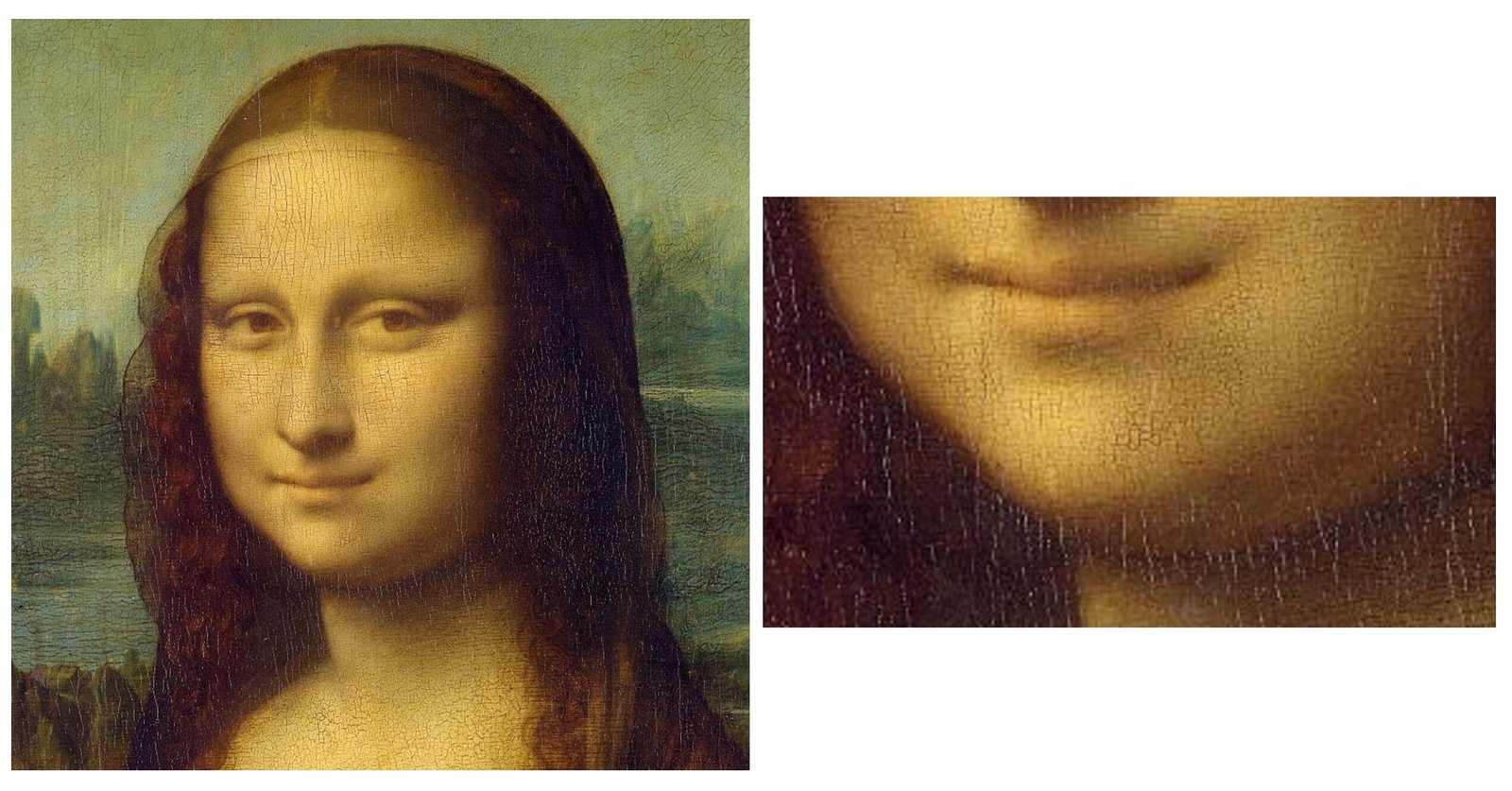
Mona Lisa (detail), Leonardo da Vinci, c. 1503–1519. Musée du Louvre, Paris.
Our retina contains two types of photoreceptors: cones, concentrated in the center, which detect fine details, and rods, located in the periphery, which only capture broader, coarser information. When we look directly at Mona Lisa’s mouth, our cones pick up every subtle nuance of her expression — and read it as melancholic. But the moment our gaze shifts elsewhere, it’s the rods that process her mouth, and since sfumato has blurred its finest details, they register something warmer — closer to a smile. (If you’d like to explore this further, Livingstone’s book is a fantastic place to start.)
Just as with Mona Lisa’s gaze, her expression never truly changes. What changes is our perception. Da Vinci painted her in a way that makes that shift inevitable — and endlessly captivating.
And then there’s the suggestion and self-persuasion part. We’ve been told again and again that her gaze is penetrating, her expression ambiguous, seductive, hypnotic — so we expect to experience exactly that. We want to “be seen” by Mona Lisa.
It’s a bit like going to a long-awaited concert of your favorite music star: you’re there, in the front row, alert to every gesture of the singer, and suddenly you’re sure he looked straight at you, directly into your eyes and heart. Maybe he did, maybe he didn’t. But in that moment, your brain wants to believe it.
The Mona Lisa works the same way: part science, part legend, and part our own imagination.
The Weight of Mona Lisa’s Legend
Of course, her fame isn’t just about her gaze and smile. Da Vinci’s mastery of composition and technique is undeniably what makes the painting extraordinary.
Yet the decades of stories, theories, and myths woven around her add another layer of power to this particular image. You might have heard the incredible — and probably totally false — anecdote of Leonardo hiring people to make the beautiful lady laugh during the sitting sessions, to capture her natural smile, or the theories suggesting that the painting is, in fact, his disguised self-portrait.
And the event that impacted the celebrity of the Mona Lisa the most was the theft of the painting from the Louvre in 1911 by an employee who wanted to return the artwork to Italy. All of this feeds the legend and keeps it alive. Combined with our brain’s natural response to faces, it’s no wonder La Gioconda leaves such a lasting impression and still sparks our imagination.
That said, not everyone feels it. Maybe you’ve never been particularly struck by the painting, or never felt her eyes on you. That’s perfectly normal, too. Overexposure can dull the effect — after all, she’s everywhere, from posters to T-shirts to souvenir-shop tissues. Paradoxically, for some people, this makes the painting almost invisible, rendering her “just another familiar face.”
A Mini Mindfulness Exercise with the “Mona Lisa”
It might be the most famous portrait in art history, but I promise there’s still something more to discover about this masterpiece.
If you’d like to experience the painting differently — or simply check whether she really does smile at you — try this short mindfulness practice. It only takes 2–3 minutes:
- Tune in. Close your eyes and take a few slow breaths, counting to four on each inhale and exhale. Repeat until you feel calmer and more focused.
- Look closely. Open your eyes and focus on Mona Lisa’s face. It’s just you and her, in this moment. Notice what feelings or emotions arise.
- Shift your gaze. Slowly walk your eyes away from her face. Study her clothing, then the background. Try to spot at least two details you’ve never noticed before.
- See the whole. Step back and take in the entire painting. Does it feel different? Has your perception shifted?
This simple practice can calm your nervous system and sharpen your focus in just a few minutes. And whether she smiles or not, the Mona Lisa is an invitation: to slow down, to look deeply, and to rediscover the quiet power of art.
Enjoyed this exercise? I have something you might love.
My free Art Meditation Kit takes you on a 10-minute guided experience with another iconic painting — Caspar David Friedrich’s Wanderer above the Sea of Fog. It combines a calming art meditation with a bite-sized piece of knowledge about the work and its background. No prior experience needed — just curiosity and a few quiet minutes.
If that sounds like your kind of thing, leave your email below, and I’ll send it straight to your inbox.
The Smile Lives On
The “Mona Lisa” has survived centuries, a theft, endless reproductions, and the relentless noise of modern culture — and she still makes us stop and stare. Perhaps that’s the greatest proof that her true power isn’t in the painting technique, but in us: in our perception and the very human need to understand other humans — or what our brain perceives as human, when faced with a portrait this alive.
Every time we see her, Mona Lisa invites us into an intimate moment of seeing and being seen. We project our own feelings onto her face, which is precisely what makes her smile so ambiguous and ensures it remains one of the greatest mysteries of art history.
And maybe that’s the real secret: she gives us just enough to spark our imagination, but never so much that the mystery disappears.
This intersection of art, perception, and mindfulness is exactly the method behind Art Wanderer Lab.
FAQs
Leonardo’s sfumato technique softens the edges of her mouth. When you look directly at it, your retinal cones read it as neutral; when your gaze shifts, peripheral rods read it as a smile. The expression doesn’t change; your perception does.
It’s the impression that a portrait’s eyes follow you around the room. A 2015 fMRI study found that once the brain registers eye contact in a painted face, it continues to perceive it from any angle, though, ironically, Mona Lisa herself may not actually gaze at the viewer.
Neuroaesthetics is a scientific discipline that studies how the brain responds to art and beauty. It uses neuroscience tools to map what happens when we look at paintings, listen to music, or experience aesthetic pleasure.
Neuroaesthetics reveals how art stimulates the brain and that knowledge is surprisingly practical. Simple practices like slow looking can sharpen your focus and attention. For a calming effect, try art meditation: a gentle way to deepen your brain’s engagement with an artwork and turn a few quiet minutes into a genuinely restorative experience.
When the brain recognizes a face in a painting or sculpture, the fusiform gyrus treats it as a living being, triggering pleasure and a sense of connection. This biological response makes figurative art feel more immediately engaging for most viewers.
Sources & Further Reading
Boyarskaya, E., Sebastian, A., Bauermann, T., Hecht, H., Tüscher, O. The Mona Lisa effect: neural correlates of centered and off-centered gaze. Human Brain Mapping. 2015 Feb;36(2):619-32. https://doi.org/10.1002/hbm.22651. Epub 2014 Oct 18. PMID: 25327821; PMCID: PMC6869588.
Chatterjee, A. (2015). The Aesthetic Brain: How We Evolved to Desire Beauty and Enjoy Art. Oxford University Press
Horstmann, G., Loth, S. The Mona Lisa Illusion-Scientists See Her Looking at Them Though She Isn’t. Iperception. 2019 Jan 7;10(1):2041669518821702.
https://doi.org/10.1177/2041669518821702. PMID: 30671222; PMCID: PMC6327345.
Lemarquis, P. “Conférence : Comment notre cerveau perçoit il les œuvres d’art ?” Université Côte d’Azur, YouTube video. Posted June 26, 2021. https://youtu.be/nK77JH60aNM?si=KPz3RH8lFpQZvaxf.
Livingstone, M. (2002). Vision and Art: The Biology of Seeing. Harry N. Abrams.
Schepman, A., Rodway, P., Pullen, S. J., Kirkham, J. Shared liking and association valence for representational art but not abstract art. Journal of Vision 2015;15(5):11. https://doi.org/10.1167/15.5.11.
Sorranzo, A. The psychology of Mona Lisa’s smile. Scienitific Reports. 2024 May 28;14(1):12250. https://doi.org/10.1038/s41598-024-59782-1. PMID: 38806507; PMCID: PMC11133332.